0 days until NEET 2026 Every question counts. ✊
🌿
Did you know?
A single strand of DNA, if uncoiled, would be ~6 feet long — yet it fits inside a cell nucleus.
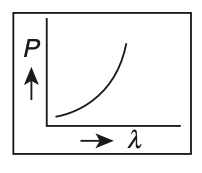
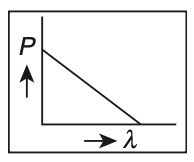
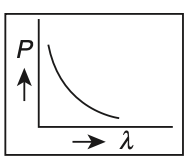
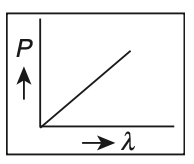
Which of the following figure represents the variation of particle momentum and the associated de Broglie wavelength?
medium
Dual Nature of Radiation and Matter
2015
physics
Explanation To solve this problem, we need to understand the relationship between momentum ( P ) (P) ( P ) and the de Broglie wavelength ( λ ) . (\lambda). \\
\\
( λ ) . The de Broglie wavelength is given by the formula: λ = h P \\
\lambda = \frac{h}{P} \\
λ = P h
Our AI powered practice platform can help you achieve your doctor dream. Practice 2000+ previous year NEET questions More practice, more score
AI generated hints Use hints to get start solving
AI companion chat to clear doubts 24*7 Ask any question, get instant answers
AI generated solutions Get detailed step by step solutions
Check related NCERT content Read while solving
Track your progress Improve every day
Sign up / Login
where
is Planck's constant and
is the momentum of the particle.
From the formula, we can see that
is inversely proportional to
This means that as the momentum increases, the wavelength decreases, and vice versa.
Let's analyze the options:
• Option 1: The graph shows an increasing curve, which suggests that as
increases,
also increases. This is incorrect.
• Option 2: The graph shows a linear decrease, which suggests a direct inverse relationship. This is correct.
• Option 3: The graph shows a decreasing curve, which suggests that as
increases,
decreases. This is also correct.
• Option 4: The graph shows an increasing linear relationship, which is incorrect.
The correct graph should show a decrease in
as
increases, which is represented by Option 3.
Therefore, the correct option is Option 3.