0days until NEET 2026Every question counts. ✊
🌊
Did you know?
Sound travels ~4× faster in water than in air — about 1,480 m/s vs 343 m/s.
Did you know?
Sound travels ~4× faster in water than in air — about 1,480 m/s vs 343 m/s.
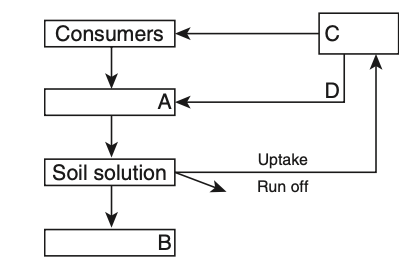
To solve this problem, we need to identify the blanks in the phosphorus cycling model. Let's analyze each component:A: This represents the flow from soil solution to plants. In the phosphorus cycle, plants uptake phosphorus from the soil. Therefore, A is Producers.B: This represents the flow from soil solution to another component. In the phosphorus cycle, phosphorus can be lost from the soil through runoff. Therefore, B is Rock minerals.C: This represents the flow from consumers back to the soil. In the phosphorus cycle, this is typically through waste and decay. Therefore, C is Detritus.D: This represents the flow from plants back to the soil. In the phosphorus cycle, this occurs through litter fall. Therefore, D is Litter fall.Now, let's match the blanks with the correct terms:Producers, B \rightarrow Rock minerals, C \rightarrow Detritus, D \rightarrow Litter fallThis corresponds to Option 3.
More practice, more score
Use hints to get start solving
Ask any question, get instant answers
Get detailed step by step solutions
Read while solving
Improve every day