0 days until NEET 2026 Every question counts. ✊
🧪
Did you know?
Hydrogen is the most abundant element in the universe, making up ~75% of all matter.
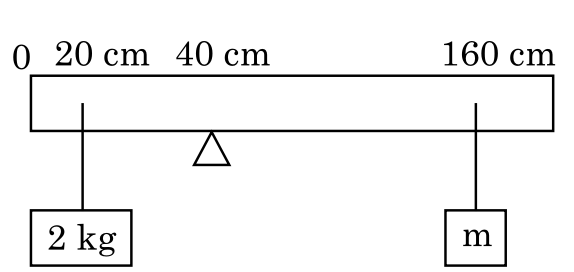
A uniform rod of length 200 200 200 cm and mass 500 500 500 g is balanced on a wedge placed at 40 40 40 cm mark. A mass of 2 2 2 kg is suspended from the rod at 20 20 20 cm and another unknown mass m m m is suspended from the rod at 160 160 160 cm mark. \newline Find the value of m m m such that the rod is in equilibrium. ( g = 10 \newline (g = 10 ( g = 10 m/s 2 ) ^2) 2 )
medium
System of Particles and Rotational Motion
2021
physics
Explanation To solve this problem, we will use the principle of moments (torque) for equilibrium. \\
Given: \\
• Length of the rod = 200 = 200 = 200 cm \\
• Mass of the rod = 500 = 500 = 500 g = 0.5 = 0.5 = 0.5
Our AI powered practice platform can help you achieve your doctor dream. Practice 2000+ previous year NEET questions More practice, more score
AI generated hints Use hints to get start solving
AI companion chat to clear doubts 24*7 Ask any question, get instant answers
AI generated solutions Get detailed step by step solutions
Check related NCERT content Read while solving
Track your progress Improve every day
Sign up / Login
kg
kg
• Mass suspended at 20 cm
kg
• Unknown mass
suspended at 160 cm
• Wedge (pivot) is at 40 cm mark
• Gravitational acceleration
m/s
The rod is uniform, so its center of mass is at the midpoint, 100 cm.
Let's calculate the torques about the pivot point at 40 cm.
Torque due to the 2 kg mass:
Distance from pivot
= 40 − 20 = 20 = 40 - 20 = 20 = 40 − 20 = 20 cm
Torque
= 2 ⋅ 10 ⋅ 20 = 400 = 2 \cdot 10 \cdot 20 = 400 = 2 ⋅ 10 ⋅ 20 = 400 N cm
Torque due to the rod's weight:
Distance from pivot to center of mass
= 100 − 40 = 60 = 100 - 40 = 60 = 100 − 40 = 60 cm
Torque
= 0.5 ⋅ 10 ⋅ 60 = 300 = 0.5 \cdot 10 \cdot 60 = 300 = 0.5 ⋅ 10 ⋅ 60 = 300 N cm
(This torque acts in the opposite direction)
Torque due to the unknown mass
Distance from pivot
= 160 − 40 = 120 = 160 - 40 = 120 = 160 − 40 = 120 cm
Torque
= m ⋅ 10 ⋅ 120 = 1200 m = m \cdot 10 \cdot 120 = 1200m = m ⋅ 10 ⋅ 120 = 1200 m N cm
For equilibrium, the sum of clockwise torques must equal the sum of counterclockwise torques:
400 + 1200 m = 300 \\
400 + 1200m = 300 \\
400 + 1200 m = 300 Solve for
m : 1200 m = 300 − 400 1200 m = − 100 m = − 100 1200 m = − 1 12 m: \\
1200m = 300 - 400 \\
1200m = -100 \\
m = \frac{-100}{1200} \\
m = \frac{-1}{12} m : 1200 m = 300 − 400 1200 m = − 100 m = 1200 − 100 m = 12 − 1 kg
Since mass cannot be negative, we must have made an error in direction.
Re-evaluate the direction:
The correct equation should be:
400 = 300 + 1200 m \\
400 = 300 + 1200m \\
400 = 300 + 1200 m Solve for
again:
1200 m = 400 − 300 1200 m = 100 m = 100 1200 m = 1 12 \\
1200m = 400 - 300 \\
1200m = 100 \\
m = \frac{100}{1200} \\
m = \frac{1}{12} 1200 m = 400 − 300 1200 m = 100 m = 1200 100 m = 12 1 kg
Therefore, the value of
is
kg.
This corresponds to Option 4.