0 days until NEET 2026 Every question counts. ✊
💧
Did you know?
Water is the only substance found naturally in all three states on Earth's surface.
Which of the following sequence of reactions is suitable to synthesize chlorobenzene?
medium
Hydrocarbons
2022
chemistry
Benzene, Cl 2 , _2, 2 , anhydrous FeCl 3 _3 3
Phenol, NaNO 2 , _2, 2 , HCl, CuCl
Explanation To solve this problem, we need to determine the correct sequence of reactions to synthesize chlorobenzene.
\newline Let's analyze each option:
\newline Option 1: Benzene, Cl 2 , _2, 2 , anhydrous FeCl 3 _3
\newline 3
Our AI powered practice platform can help you achieve your doctor dream. Practice 2000+ previous year NEET questions More practice, more score
AI generated hints Use hints to get start solving
AI companion chat to clear doubts 24*7 Ask any question, get instant answers
AI generated solutions Get detailed step by step solutions
Check related NCERT content Read while solving
Track your progress Improve every day
Sign up / Login
• This is a classic example of electrophilic aromatic substitution.
• Benzene reacts with chlorine in the presence of anhydrous FeCl
to form chlorobenzene.
• The reaction is:
Benzene
+ C l 2 → F e C l 3 + Cl_2 \xrightarrow{{FeCl}_3} + C l 2 F e Cl 3 Chlorobenzene
This sequence is correct for synthesizing chlorobenzene.
Option 2: Phenol, NaNO
HCl, CuCl
• This sequence involves diazotization and Sandmeyer reaction.
• Phenol is converted to a diazonium salt, which can be converted to chlorobenzene using CuCl.
• However, starting from phenol is not the most direct route to chlorobenzene.
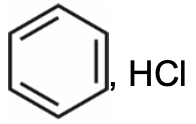
Option 3: Benzene, HCl
• This option lacks a catalyst or halogen carrier, so it is not suitable for chlorination.
• Benzene does not react with HCl directly to form chlorobenzene.
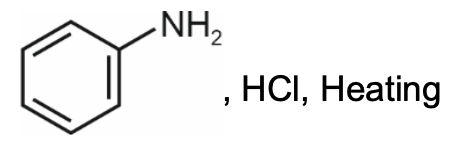
Option 4: Aniline, HCl, Heating
• This involves converting aniline to a diazonium salt, followed by heating to form chlorobenzene.
• This is a possible route but requires additional steps and reagents.
Therefore, the most suitable sequence of reactions to synthesize chlorobenzene is Option 1.