0days until NEET 2026Every question counts. ✊
🧠
Did you know?
The human brain has ~86 billion neurons, each connected to up to 7,000 others.
Did you know?
The human brain has ~86 billion neurons, each connected to up to 7,000 others.
A capacitor of 2 μF is charged as shown in the diagram. When the switch S is turned to position 2, the percentage of its stored energy dissipated is
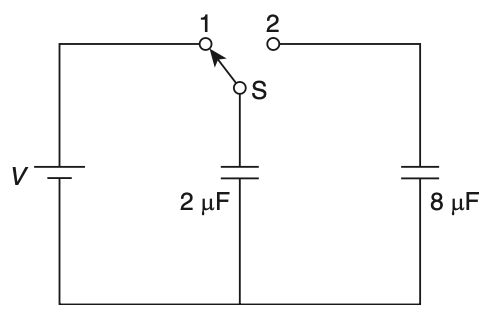
75%
80%
0%
20%
To solve this problem, we need to calculate the energy dissipated when the switch is moved from position 1 to position 2.Initially, the 2 μF capacitor is charged to a voltage The initial energy stored in the 2 μF capacitor is given by:When the switch is moved to position 2, the 2 μF capacitor is connected in parallel with the 8 μF capacitor.The total capacitance is:The charge on the 2 μF capacitor is:This charge is now distributed over the total capacitance, so the new voltage is:The final energy stored in the system is:The energy dissipated is:The percentage of energy dissipated is:PercentagePercentagePercentageTherefore, the percentage of stored energy dissipated is , which corresponds to Option 2.
More practice, more score
Use hints to get start solving
Ask any question, get instant answers
Get detailed step by step solutions
Read while solving
Improve every day