0days until NEET 2026Every question counts. ✊
🌿
Did you know?
A single strand of DNA, if uncoiled, would be ~6 feet long — yet it fits inside a cell nucleus.
Did you know?
A single strand of DNA, if uncoiled, would be ~6 feet long — yet it fits inside a cell nucleus.
In the given circuits (a), (b), and (c), the potential drop across the two p-n junctions are equal in:
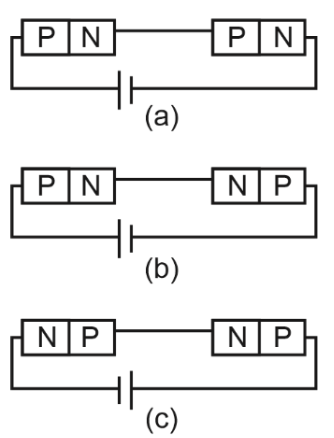
Circuit (a) only
Circuit (b) only
Circuit (c) only
Both circuits (a) and (c)
To solve this problem, we need to analyze the potential drop across the p-n junctions in each circuit.In a p-n junction, the potential drop depends on the biasing of the junction:• Forward bias reduces the potential barrier, allowing current to flow easily.• Reverse bias increases the potential barrier, preventing current flow.Let's analyze each circuit:Circuit (a):• Both p-n junctions are forward biased.• The potential drop across each junction is equal because they are identical and equally biased.Circuit (b):• The first junction (p-n) is forward biased, while the second junction (n-p) is reverse biased.• The potential drops are not equal due to different biasing.Circuit (c):• Both n-p junctions are reverse biased.• The potential drop across each junction is equal because they are identical and equally biased.Conclusion:The potential drop across the two p-n junctions is equal in circuits (a) and (c).Therefore, the correct option is 4: Both circuits (a) and (c).
More practice, more score
Use hints to get start solving
Ask any question, get instant answers
Get detailed step by step solutions
Read while solving
Improve every day