0 days until NEET 2026 Every question counts. ✊
🧬
Did you know?
Humans share ~60% of their DNA with a banana — we're more similar to fruit than you'd think.
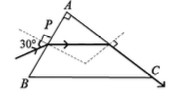
A light ray enters through a right-angled prism at point P with the angle of incidence 30 ∘ 30^\circ 3 0 ∘ as shown in figure. It travels through the prism parallel to its base BC and emerges along the face AC. The refractive index of the prism is:
hard
Ray Optics and Optical Instruments
2024
physics
Explanation To solve this problem, we need to determine the refractive index of the prism. \\
Given: \\
• The angle of incidence at point P P P is 30 ∘ . 30^\circ. \\
3 0 ∘ . • The light ray travels parallel to the base B C . BC. \\
BC .
Our AI powered practice platform can help you achieve your doctor dream. Practice 2000+ previous year NEET questions More practice, more score
AI generated hints Use hints to get start solving
AI companion chat to clear doubts 24*7 Ask any question, get instant answers
AI generated solutions Get detailed step by step solutions
Check related NCERT content Read while solving
Track your progress Improve every day
Sign up / Login
Let's denote:
•
θ 1 = 30 ∘ \theta_1 = 30^\circ θ 1 = 3 0 ∘ as the angle of incidence.
•
as the angle of refraction at point
Since the light travels parallel to the base, it makes an angle of
with the normal at the second face.
Using Snell's Law at point
P : n 1 sin θ 1 = n 2 sin θ 2 P: \\
n_1 \sin \theta_1 = n_2 \sin \theta_2 \\
P : n 1 sin θ 1 = n 2 sin θ 2 Assuming the prism is in air,
n 1 = 1. sin 30 ∘ = n 2 sin θ 2 n_1 = 1. \\
\sin 30^\circ = n_2 \sin \theta_2 \\
n 1 = 1. sin 3 0 ∘ = n 2 sin θ 2 Simplify:
1 2 = n 2 sin θ 2 \\
\frac{1}{2} = n_2 \sin \theta_2 \\
2 1 = n 2 sin θ 2 Since the light travels parallel to the base, the angle of refraction at the second face is
Thus, the angle of incidence at the second face is
90 ∘ − θ 2 . 90^\circ - \theta_2. \\
9 0 ∘ − θ 2 . Using Snell's Law at the second face:
n 2 sin θ 2 = n 1 sin 0 ∘ \\
n_2 \sin \theta_2 = n_1 \sin 0^\circ \\
n 2 sin θ 2 = n 1 sin 0 ∘ Since
sin 0 ∘ = 0 , \sin 0^\circ = 0, sin 0 ∘ = 0 , the light must be internally reflected.
For internal reflection,
must be the critical angle:
sin θ 2 = 1 n 2 \\
\sin \theta_2 = \frac{1}{n_2} \\
sin θ 2 = n 2 1 From
1 2 = n 2 sin θ 2 , \frac{1}{2} = n_2 \sin \theta_2, 2 1 = n 2 sin θ 2 , we have:
sin θ 2 = 1 2 n 2 \\
\sin \theta_2 = \frac{1}{2n_2} \\
sin θ 2 = 2 n 2 1 Equating the two expressions for
sin θ 2 : 1 2 n 2 = 1 n 2 \sin \theta_2: \\
\frac{1}{2n_2} = \frac{1}{n_2} \\
sin θ 2 : 2 n 2 1 = n 2 1 This implies:
n 2 = 5 2 \\
n_2 = \frac{\sqrt{5}}{2} \\
n 2 = 2 5 Therefore, the refractive index of the prism is
5 2 . \frac{\sqrt{5}}{2}. \\
2 5 . This corresponds to Option 4.